The debate surrounding immigration management within the European Union has reached a historic turning point. During a recent visit to the Canary Islands, Pope Francis made a direct international appeal, criticizing global indifference toward the humanitarian crisis and firmly demanding the opening of legal, regulated, and safe pathways for migrants.
However, the response from the European bloc is far from uniform. While Brussels and most member states lock down their borders with increasingly restrictive regulations, Spain has decided to take a diametrically opposed path. With the approval of an extraordinary legalization plan aimed at bringing over 500,000 undocumented individuals out of the shadows, the country has become the center of attention for international analysts.
Living in the Shadows: The Driving Force Behind the Regularization Plan
To understand the magnitude of this measure, it is essential to look at the social reality it seeks to correct. Thousands of migrants in Spain are forced to spend years in a legal limbo. Testimonies gathered by international networks like Deutsche Welle (DW) describe this as “living in the shadows”—working without a formal contract, receiving wages exclusively in cash, and completely lacking the safety net provided by state social security contributions.
The Spanish government’s new plan aims to tackle this situation by streamlining the pathways to obtain legal residency. Unsurprisingly, the announcement has triggered an immediate and massive wave of inquiries across the legal sector.
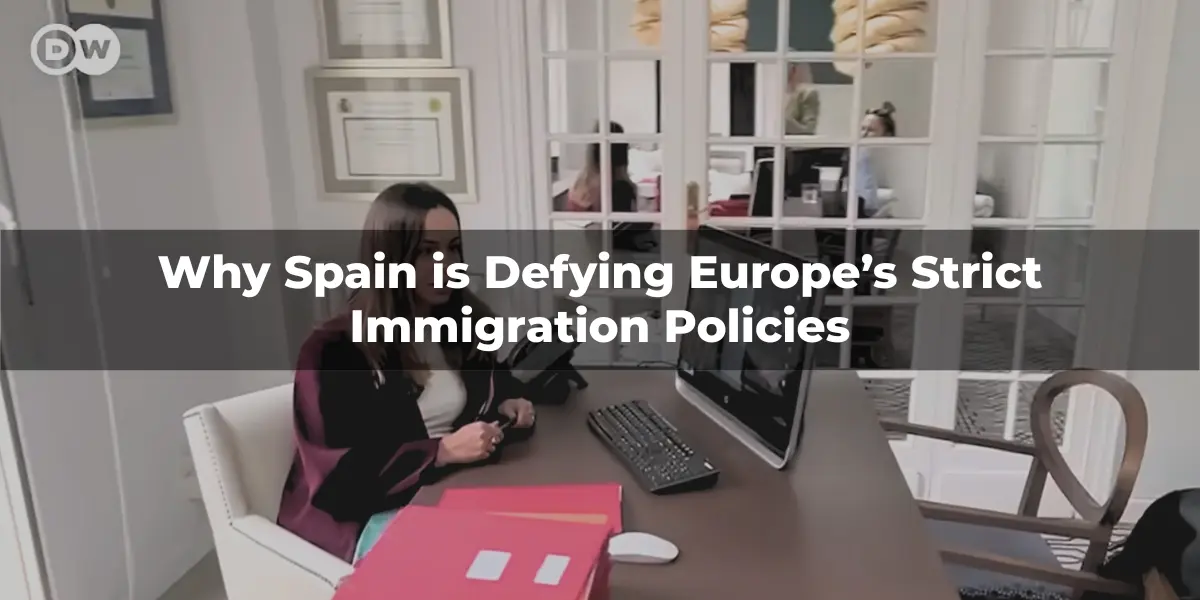
At Sterna Abogados, we are experiencing this reality on the front lines. In fact, in a recent investigative report by the German public broadcaster DW News, our expert immigration attorney, Marta Millán, was featured as a leading voice to analyze the current situation. Marta highlighted the immense pressure and saturation that specialized legal firms are experiencing due to the sheer volume of applications from foreign nationals seeking, once and for all, to regularize their employment and family status in the country.
A Clash of Strategies: Spain vs. the EU’s New Migration Pact
The direction chosen by Spain contrasts sharply with the European Union’s New Pact on Migration and Asylum. This European agreement focuses heavily on tightening border controls, accelerating deportations, and implementing strict mechanisms to manage so-called “capacity gaps” at the external borders.
Why has Spain decided to distance itself from this punitive trend? The answer lies in a combination of economic pragmatism and demographics. International experts from institutions such as the Migration Policy Institute point out that keeping large segments of the population in an unauthorized status has harmful long-term economic effects. It depresses general wages, fuels the underground economy, and economically isolates entire communities. Spain, facing an aging population and a critical shortage of labor in key sectors, has opted to “reset” the system: bringing that underground economy to light, converting informal workers into tax-paying contributors, and providing stability to the labor market.
Legal Rigor: Debunking Myths About Access to Social Benefits
As with any major reform, this extraordinary legalization process has been accompanied by intense political debate and its share of misinformation online. One of the most widespread myths is that obtaining legal status automatically grants access to a network of government subsidies and social benefits without any reciprocal contribution.
From the legal perspective of Sterna Abogados, it is vital to approach these claims with strict legal rigor. Regularization is not a free concession of state resources. On the contrary, it requires compliance with strict criteria regarding time spent in the country, clean criminal records, and, in the vast majority of cases, a connection to a real employment contract or a viable self-employment project. What this law grants is not a subsidy, but the legitimate right to work, contribute to social security, and compete fairly in the labor market—thereby generating wealth for the state rather than relying on it.
Securing Your Legal Future in Spain
Despite the restrictive policies prevailing across the rest of the continent, the legal landscape in Spain establishes itself this year as a unique window of opportunity and stability for the migrant population. However, given the administrative complexity and the clear saturation of immigration offices that our team knows all too well, every application must be handled with meticulous precision to avoid delays or unwanted rejections.
If you meet the residency criteria or want to evaluate whether you can benefit from this extraordinary legalization window, do not leave your future to chance. At Sterna Abogados, we put at your disposal the very same technical and legal expertise that international media outlets rely on to understand immigration policy.