What happens when an entrepreneur obtains a residence permit after successfully demonstrating that their business project is innovative, only to have its renewal refused years later without a clear explanation of what has changed?
This was the situation faced by one of our clients and his family after the Spanish authorities rejected the renewal of their Entrepreneur Residence Permit, originally granted under Law 14/2013 following a favourable innovation assessment by ENISA.
The Administration argued that the conditions which had justified the initial approval were no longer met. However, the decision failed to explain which specific requirements had allegedly ceased to exist or why the project was no longer considered innovative.
After exhausting the administrative appeal process, Sterna Abogados filed a judicial appeal before the High Court of Justice of Madrid. The Court partially upheld the appeal, annulled the administrative decision, ordered the authorities to reopen the proceedings and required a new assessment supported by adequate legal reasoning.
This case highlights an important principle for international entrepreneurs: even when the Administration enjoys a degree of technical discretion, its decisions must always be properly reasoned and respect the applicant’s right to an effective defence.
The client’s situation
Our client had obtained his initial Entrepreneur Residence Permit in 2022 together with residence permits for his family members.
The permit was granted after ENISA issued a favourable report confirming that the business project met the legal requirements regarding innovation and economic interest established under Spanish legislation.
Over the following years, the company continued operating normally. The business remained active, complied with all tax and Social Security obligations and continued developing the same commercial activity that had originally justified the residence permit.
When the time came to renew the permit, however, the authorities rejected both his application and those submitted by his family.
The refusal was based on a new report issued by ENISA stating that the project no longer fulfilled the conditions required for renewal.
The main problem was immediately apparent. The administrative decision merely relied on general statements without identifying what had actually changed since the original approval. It did not explain which legal requirements were allegedly no longer satisfied or why the project had ceased to qualify as innovative.
For any entrepreneur, defending against such a decision becomes extremely difficult when the Administration fails to explain the factual and legal reasons supporting its conclusions.
How does the renewal of the Entrepreneur Residence Permit actually work?
Spain’s Entrepreneur Residence Permit, regulated by Law 14/2013, was created to attract innovative business projects capable of generating economic value for the country.
One of the questions most frequently raised by international entrepreneurs concerns the renewal process. Many applicants assume they must prove exactly the same requirements that were assessed when they first applied. In reality, this is not the case. A renewal application is not intended to repeat the initial assessment from the beginning. Instead, its purpose is to verify that the essential conditions that justified the original authorisation continue to exist and that the business project remains active. This distinction is particularly important. During a renewal procedure, the Administration cannot simply reassess the application as though it were an entirely new request while disregarding the business activity already carried out over several years.
The fact that a company has continued operating, meeting its legal obligations and developing the project originally approved must be properly taken into account throughout the renewal process.
Our legal strategy
From the outset, Sterna Lawyers considered that the main issue was not the negative ENISA report itself, but the Administration’s complete failure to explain the reasons behind its decision.
Our legal strategy was built around four key arguments.
1. Demonstrating the continuity of the business project
First, we provided evidence that the company remained fully operational.
The business continued carrying out the same economic activity that had supported the original residence permit and remained fully compliant with its tax and Social Security obligations.
These elements demonstrated that the project had not been abandoned and that its core business activity continued to exist.
2. Challenging the Administration’s contradictory position
We also highlighted a fundamental inconsistency in the Administration’s reasoning.
When the residence permit was initially granted, the authorities had accepted that the project met the legal requirements regarding innovation and economic interest.
Years later, however, they simply concluded that those conditions were no longer fulfilled without identifying any objective change capable of justifying such a different outcome.
Our appeal argued that this unexplained change of position undermined the principles of legal certainty and legitimate expectations, particularly for foreign entrepreneurs who rely on the stability and predictability of administrative decisions when investing in Spain.
3. Challenging the lack of proper reasoning
One of the central arguments of the appeal concerned the Administration’s duty to provide adequate reasons for its decisions.
According to well-established Spanish case law, any administrative decision that adversely affects an individual must clearly explain the factual and legal grounds supporting the outcome.
Only then can the affected person properly understand the decision and effectively exercise their right of defence.
In this case, the generic references to the alleged loss of the project’s innovative character fell far short of that legal standard.
4. Invoking the principle of good administration
Finally, we argued that the authorities had failed to comply with the broader principle of good administration, which requires public bodies to act with transparency, objectivity and diligence.
This principle goes beyond simply citing the applicable legislation.
It requires the Administration to conduct a genuine assessment of each case and to provide sufficiently detailed reasoning capable of demonstrating why a particular decision has been reached.
Where that obligation is not fulfilled, judicial review becomes essential to protect the procedural rights of applicants.
The High Court of Justice of Madrid’s decision
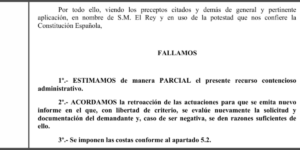
The High Court of Justice of Madrid largely agreed with the arguments put forward by Sterna Lawyers.
The Court acknowledged that concepts such as innovation and economic interest involve a certain degree of technical assessment by the Administration. However, it also made it clear that this discretionary power does not exempt public authorities from their obligation to provide proper reasoning for their decisions.
In its judgment, the Court found that the Administration had failed to explain which specific conditions had allegedly ceased to exist or what factual changes justified reaching a different conclusion from the one that had supported the original residence permit.
As a result, the Court concluded that the applicant had been deprived of the opportunity to understand the real basis for the refusal and, consequently, had been unable to fully exercise his right of defence.
For these reasons, the High Court annulled the administrative decision and ordered the authorities to reopen the proceedings. It also required the Administration to carry out a new assessment of the application supported by adequate reasoning, allowing the applicant to understand the basis of any future decision.
Finally, the Court ordered the Administration to pay the legal costs of the proceedings.
The enforcement stage: an equally important phase
The case did not end with the judgment.
After obtaining the Court’s decision, Sterna Lawyers formally initiated the enforcement stage to ensure that the Administration fully complied with the ruling.
This phase is often overlooked but can be just as important as the judicial proceedings themselves.
When a court orders the Administration to reopen a procedure, the authorities cannot simply start the process again under whatever conditions they choose. The scope of the reassessment is defined by the judgment and must respect the legal framework applicable at the time the original application was submitted.
For this reason, we argued that the renewed assessment had to be based exclusively on the documentation and factual circumstances that existed when the renewal application was originally filed.
In other words, the Administration could not rely on events that occurred after the application had been submitted or impose requirements that would only apply to an initial application rather than a renewal.
We also requested that, should the authorities consider any documentation incomplete or insufficient, the applicant be granted the opportunity to correct or supplement the file before any new decision was adopted. This safeguard is essential to prevent applicants from being placed in a situation of procedural disadvantage.
Ensuring proper compliance with a court judgment is a fundamental part of protecting our clients’ rights. A successful judgment only achieves its purpose when it is correctly implemented by the Administration.
What can other entrepreneurs learn from this case?
This case offers several important lessons for international entrepreneurs seeking to renew their residence permits in Spain.
The first is that a renewal application is not the same as an initial application. Although the authorities must verify that the essential conditions of the project continue to exist, they cannot ignore the business activity already carried out or reassess the application as if the entrepreneur were applying for the first time.
The second lesson is that administrative decisions must always be properly reasoned.
Simply referring to a negative technical report or making general statements is not enough. Applicants have the right to understand why a decision has been taken so they can effectively challenge it if necessary.
The case also demonstrates that technical reports issued by ENISA are not beyond judicial scrutiny. While they play an important role in the assessment process, the courts retain the authority to review whether the Administration has acted lawfully and respected the procedural rights of applicants.
Finally, this matter illustrates the importance of the enforcement stage following a successful judgment. Obtaining a favourable court decision is only part of the process; ensuring that the Administration correctly implements the ruling is often equally critical.
Conclusion
Spain’s Entrepreneur Residence Permit remains one of the country’s most attractive immigration pathways for innovative founders wishing to establish their businesses in Europe.
However, renewal applications can become particularly complex when administrative authorities change their assessment of a project without providing clear and legally sufficient reasons.
This case demonstrates that administrative decisions are subject to judicial review and that entrepreneurs are entitled to expect transparency, consistency and respect for their procedural rights throughout the renewal process.
Every renewal application is unique and requires a careful legal assessment, particularly where negative ENISA reports, changes in administrative criteria or questions regarding the innovative nature of the project arise.
If you are preparing to renew your Entrepreneur Residence Permit or have received an unfavourable decision, obtaining specialised legal advice can be crucial to protecting your project and your rights in Spain. Visit our work permit for entrepreneurs in Spain page to explore the available options and determine the most effective strategy for your case.