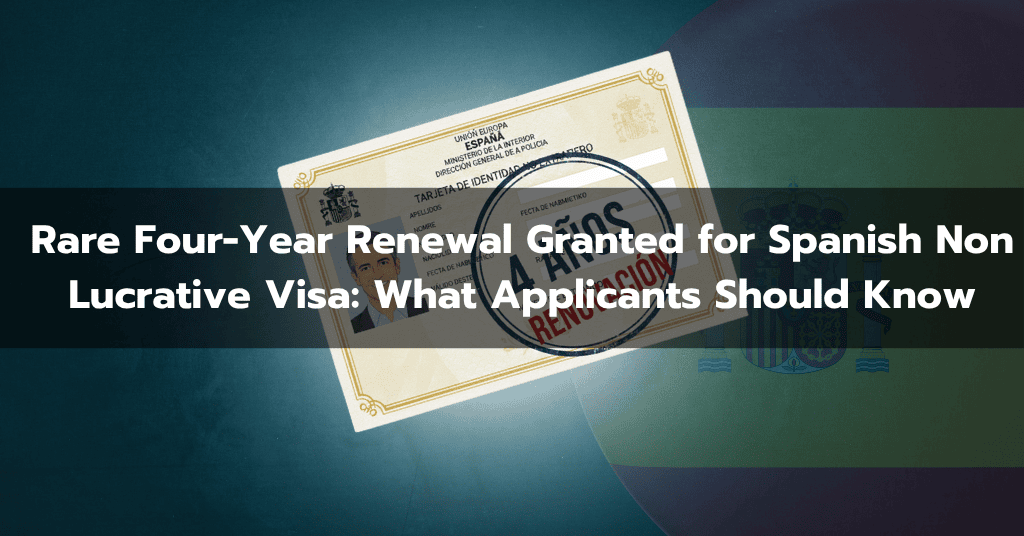
In an exceptional case recently managed by Sterna Abogados, a client’s Spanish Non Lucrative Visa was renewed for four years instead of the usual two. Immigration lawyer Ainhoa Manero shared details of this unusual outcome, which has caught the attention of many expats and visa holders curious to know whether this could mark a policy shift or a simple administrative oversight.

Standard Duration for Spanish Non Lucrative Visa Renewals
Under the existing Spanish Non Lucrative Visa regulations, applicants are first granted a one-year residence permit, which can then be renewed for an additional two years at a time. This rule is clearly outlined in the Reglamento de Extranjería (Article 64), which governs all non-lucrative residence authorizations in Spain.
As Ainhoa explains, “The bylaw is very clear — renewals of the non-lucrative residence are meant to be for two years.”
For that reason, receiving a renewal valid for four years came as a complete surprise — both for the applicant and for our legal team.
The Four-Year Renewal Case in Galicia
The case took place in La Coruña, within the Galicia region. Sterna Abogados submitted a standard renewal application demonstrating the client’s financial means for one year, as typically required.
To everyone’s surprise, the immigration office approved a four-year renewal. This is particularly remarkable because they commonly issue two-year renewals. Extending the permit for four years (and also, without increasing the proof of means) is, therefore, highly unusual.
Administrative Error or Policy Change?
According to Ainhoa Manero, this outcome does not reflect a policy change but rather a clerical or administrative mistake by the immigration office.
“It should have been for two years if you read the bylaw. But in this case, it turned out to be a positive mistake for the client.”
While it’s rare for such administrative errors to work in favor of applicants, this particular instance allowed the client to extend their legal stay in Spain for four years — without needing another renewal during that period.
Can Other Applicants Request a Four-Year Renewal?
This isolated case cannot be used as a precedent for other renewals. As Ainhoa points out, “The regulation is explicit — the renewal period is two years. Using this case as an argument could be risky.”
If another immigration office were to review a similar case, they could easily amend the resolution and reduce the renewal period to the standard two years. While the Galicia case shows that positive surprises can happen, it should not be interpreted as a new national practice.
Regional Variations in Immigration Procedures
Spanish immigration processes can differ slightly from one region to another. Each provincial immigration office may interpret or apply parts of the regulations differently.
Sterna Abogados handles non-lucrative visa renewals across multiple provinces and has observed that documentation requirements, financial thresholds, and even timelines may vary. Nonetheless, the two-year renewal period remains the norm throughout Spain.
Key Takeaways for Visa Holders
While applicants shouldn’t expect four-year renewals to become common practice, this case highlights that unexpectedly favorable outcomes can sometimes occur in the Spanish immigration system.
If you are preparing to renew your Spanish Non Lucrative Visa, make sure to:
-
Provide evidence of sufficient financial means, typically and at least for one year, depending on the area in Spain.
- Ensure your private health insurance policy remains active and meets Spanish visa requirements — coverage gaps are a common reason for renewal complications.
-
Expect a two-year renewal, as stipulated by the law.
-
Keep in mind that regional immigration offices may interpret the process slightly differently.
As Ainhoa summarizes: “Normally, immigration mistakes cause complications. But in this instance, it was a fortunate one — and we wanted to share this good news.”
Conclusion
The Spanish Non Lucrative Visa framework remains unchanged: one year for the initial permit, followed by renewals of two years each. The four-year renewal granted in Galicia appears to be a one-off administrative error, not a systemic change.
Nevertheless, it serves as a reminder that each case can be unique, and consulting experienced professionals like Sterna Abogados can make all the difference when navigating Spanish immigration procedures.