Golden Visa in Spain: Madrid High Court provisionally maintains investors’ residence during judicial proceedings
The abolition of the Golden Visa in Spain has created complex legal situations for foreign investors who had already started or completed their investments before the legislative changes came into force.
This was the case for several clients represented by Sterna Abogados, U.S. nationals who had initially obtained residence permits for investors and their family members after signing a private deposit agreement (arras contract) for the purchase of a property in Gijón. They subsequently completed the transaction through a public deed of sale and later applied to renew their residence permits.
However, the Spanish authorities declared their renewal applications inadmissible. In response, Sterna Abogados filed a judicial review claim before the administrative courts and requested interim relief to prevent the clients from losing the benefits of their residence permits while the court proceedings were ongoing.
The High Court of Justice of Madrid (Tribunal Superior de Justicia de Madrid) granted the interim measure requested, suspending the administrative decisions under challenge and provisionally maintaining the effects of the investor residence permits and the related family permits during the judicial proceedings.
What was the clients’ situation?
The clients initially applied for investor residence permits in March 2025 based on a deposit agreement for the purchase of a property located in Gijón. Their residence permits were approved in April 2025.
Following the initial approval, the real estate transaction progressed and was formally completed through the execution of the public deed of sale.
Several months later, in October 2025, they applied for the renewal of their permits, submitting the full documentation relating to the investment, including the final deed of sale.
Nevertheless, the Administration declared the applications inadmissible, arguing that a permit initially granted on the basis of a preliminary purchase agreement could not be renewed and that a new investor residence authorization could not be requested after the entry into force of Organic Law 1/2025.
The issue was particularly sensitive because, if the administrative decisions remained fully effective during the litigation, the clients could lose the benefits of residence permits they had already been enjoying.
The context: the end of the Golden Visa and the transitional regime
Organic Law 1/2025 substantially modified Spain’s investor residence framework and brought an end to the well-known Golden Visa programme, with effect from 3 April 2025.
However, the transitional provisions are particularly important for individuals who had already submitted applications or held permits before the legislative change.
According to the official information published under Spain’s Residence Programme for Investors and Entrepreneurs, the transitional regime allows previously granted investor visas and residence permits to be renewed under the rules that were in force at the time the initial authorization was issued.
Against this backdrop, the case raised an important legal question: whether an investment initially evidenced by a deposit agreement and later completed through a public deed of sale should be considered part of the same investment process protected by the transitional regime.
Our legal strategy
Sterna Abogados’ legal strategy focused on preventing the Administration from closing the debate through a formal inadmissibility decision without addressing the substantive merits of the case.
We argued that there was a clear continuity between the initial deposit agreement and the subsequent public deed of sale. In other words, this was not a new or unrelated investment, but rather the natural completion of the same real estate transaction that had originally given rise to the investor residence permit.
We also maintained that the Administration had relied on an artificial inadmissibility argument in order to avoid a proper assessment of the merits, contrary to the principles of legality and good administration.
Additionally, we requested interim relief to suspend the effects of the challenged administrative decisions. The objective was to prevent the passage of time during the judicial proceedings from causing irreparable harm to our clients.
The administration’s opposition
The Spanish State Attorney’s Office opposed the request for interim relief.
It argued that there was no risk of serious or irreparable harm, that the requested measure was positive in nature, and that interim proceedings could not be used to obtain in advance the outcome sought in the main proceedings.
The Administration also contended that the public interest should prevail and that there was insufficient appearance of good legal grounds to justify suspending the administrative acts.
The decision of the Madrid High Court
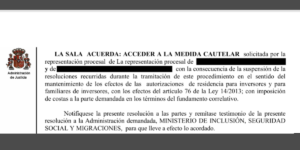
The High Court of Justice of Madrid upheld our request for interim relief.
The Court ordered the suspension of the challenged administrative decisions and provisionally maintained the effects of the investor and family residence permits while the judicial proceedings continue.
The Court considered that the risk arising from procedural delay had been sufficiently demonstrated. In particular, it found that refusing the measure could cause significant harm, including the loss of lawful immigration status and the potential obligation to leave Spain, thereby rendering any future favourable judgment ineffective.
The Court also took into account that Article 76 of Law 14/2013 establishes that a renewal application extends the validity of the authorization until a decision is issued.
Furthermore, the Court concluded that granting the interim measure would not seriously affect the public interest or the rights of third parties.
As a result, the clients have been able to retain the effects of their residence permits while the judicial appeal remains pending.
What can foreign investors learn from this case?
This case demonstrates that, following the abolition of the Golden Visa programme, not every situation should automatically be treated as a new application.
Where there is a previously granted permit, an investment that had already commenced, or a real estate transaction completed in different stages, it may be essential to carefully assess the application of the relevant transitional provisions.
The case also highlights the importance of acting quickly when a renewal application is declared inadmissible or denied. In certain circumstances, obtaining interim relief may be crucial to prevent judicial proceedings from arriving too late to provide effective protection.
Finally, this matter serves as a reminder that an administrative inadmissibility decision is not always the end of the road. Where the Administration fails to assess the merits of an application or applies legislative amendments too rigidly, there may be grounds to challenge the decision before the courts.
Conclusion
The termination of Spain’s Golden Visa programme has created significant uncertainty for foreign investors and their families, particularly in cases involving prior applications, pending renewals, or investments completed in several stages.
In this case, the High Court of Justice of Madrid ordered the provisional maintenance of the residence permits during the judicial appeal, ensuring that the clients were not left without protection while the substantive issues of the case are being resolved.
If you have received a renewal refusal or an inadmissibility decision relating to an investor residence permit in Spain, it is advisable to seek legal advice as soon as possible in order to assess the decision, the timing of the application, the supporting documentation submitted, and the possible application of the transitional regime.